
Found a Baby Bird? How to Tell If It Really Needs Help
On this page
If you have found a baby bird, the kindest thing is usually to leave it where it is. Most young birds found on the ground in spring and summer are fledglings – healthy youngsters learning to fly, with their parents close by and still feeding them. Only birds that are injured, in immediate danger or too young to be out of the nest need help.
Knowing the difference takes a minute or two of careful looking. This guide explains how to tell what kind of bird you have found and what to do next.
Key Points
- Fledglings on the ground are normal – they leave the nest before they can fly well, and their parents keep caring for them.
- Nestlings out of the nest need help – the best option is usually to return them to their nest if it is safe.
- Keep cats and dogs indoors or away while a young bird is nearby.
- Injured birds, or those caught by a cat, need a wildlife rescue or vet as soon as possible.
- Do not try to feed, give water to or raise a wild bird at home.
Nestling Or Fledgling? How To Tell
The first step is working out how old the bird is. Young birds fall broadly into two groups, and the right response is quite different for each.
| Nestling | Fledgling | |
|---|---|---|
| Feathers | Bare skin, fluffy down or feathers just emerging as spiky quills | Mostly or fully feathered, often with a short tail |
| Eyes | May be closed or only partly open | Open and alert |
| Movement | Cannot hop, perch or grip firmly | Hops, flutters and can grip your finger or a twig |
| Where it should be | In the nest | On the ground or in low branches, near cover |
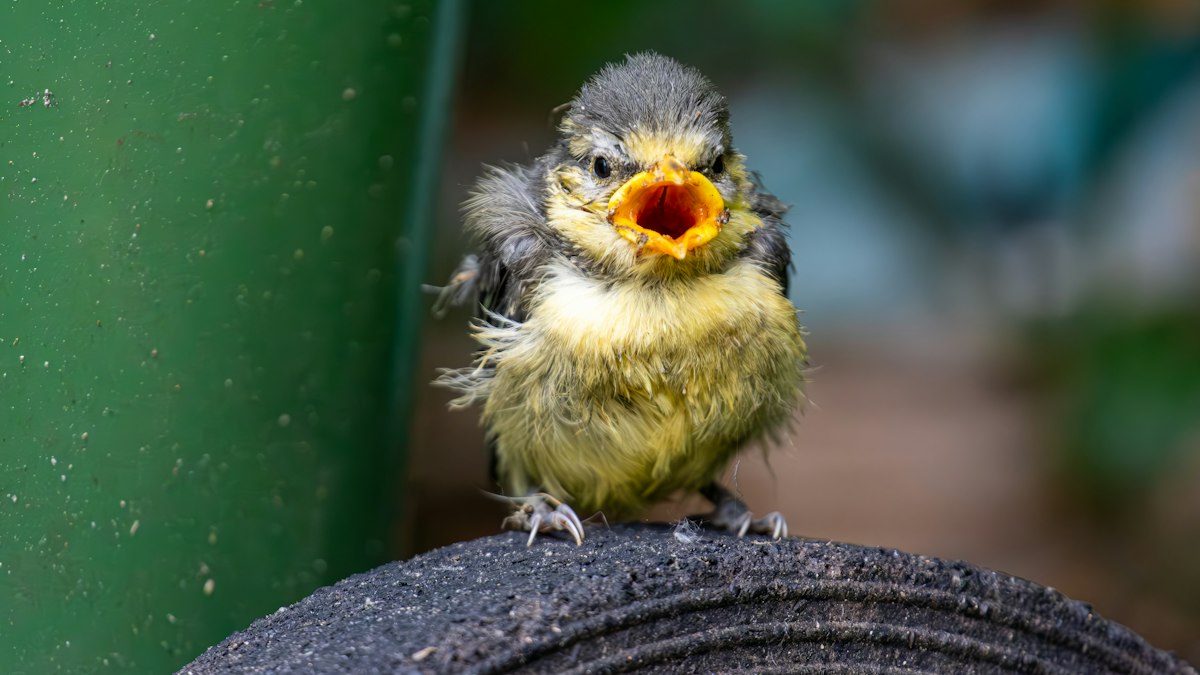
A fledgling may look scruffy, slightly clumsy and a little lost. That is perfectly normal for this stage of life. It may sit still for long periods, which is a natural way of avoiding attention from predators.
Why Most Fledglings Don’t Need Rescuing
Many common garden birds leave the nest before they can fly properly. They spend several days on or near the ground, hopping between bushes and gradually building up their flying skills. During this time, the parents stay nearby and keep bringing food, often coming and going so quickly that you may not notice them.
Picking up a healthy fledgling and taking it indoors, however well meant, separates it from parents who are far better at raising it than any person could be. It also removes the bird from the chance to learn the skills it needs to survive in the wild. For a healthy fledgling, the best help is usually to step back.
If you want to be sure the parents are around, watch from a distance – from inside the house, or well away in the garden – for an hour or two. Parent birds will not approach while people are standing close by.
What To Do If You Find A Fledgling
In most cases, simply leave it alone. A few simple actions can help it stay safe:
- Check for injuries. Look from a distance for bleeding, a drooping wing, a leg held at an odd angle or obvious wounds. If you see any, contact a wildlife rescue or vet.
- Move it only if it is in immediate danger. If the bird is on a road, path or open lawn, gently move it a short distance into nearby cover such as a hedge or shrub. Stay within a few metres so the parents can still find it.
- Keep pets away. Bring cats indoors and keep dogs on a lead or inside for a few days if possible. This is one of the most helpful things you can do.
- Keep children and people back so the parents feel safe to return.
It is a common myth that parent birds will abandon a chick that has been touched by people. Most birds do not reject their young because of human scent. Still, handle a bird only when you need to, briefly and gently, and wash your hands afterwards.
What To Do If You Find A Nestling
A nestling that has fallen out of the nest cannot survive on the ground for long. If you can see the nest and can reach it safely, gently place the chick back inside. Do not take risks on ladders or climb trees to do this.
If the nest has fallen or been destroyed, you can make a simple replacement. Use a small container such as a margarine tub or a small basket with drainage holes punched in the base, line it with dry grass or kitchen roll, and fix it securely in the same bush or tree, as close to the original spot as possible and out of direct sun. Place the nestling inside, then move well away and watch from a distance.
If the parents do not return after a reasonable period of watching, or if you cannot find or replace the nest, contact a local wildlife rescue for advice rather than taking the bird indoors to care for it yourself.
Keeping Pets Away From Young Birds
Cats are natural hunters, and fledglings on the ground are easy targets. Even a well-fed, gentle cat may catch a young bird. During the breeding season, which in the UK runs broadly from spring through summer, it helps to:
- Keep cats indoors around dawn and dusk, when birds are especially active
- Keep cats in for a few days if you know there are fledglings in your garden
- Supervise dogs in the garden and call them away from hedges and shrubs
- Place bird feeders and baths away from spots where cats can hide and pounce
If your cat brings in a bird, even one that looks unhurt, treat it as an emergency. Bites and scratches from a cat can cause serious infection, and the bird is likely to need urgent professional care.
If A Bird Needs Help: Safe Short-Term Steps
When a bird is injured or clearly in trouble, the aim is to keep it calm and safe until you can get expert advice. Contact a wildlife rescue or vet first if you can, and follow their instructions. While you wait, general steps include:
- Gently place the bird in a small cardboard box lined with a soft towel or kitchen roll, with a few small air holes in the lid.
- Keep the box somewhere quiet, dark and warm, away from pets, children and noise.
- Avoid handling or checking on the bird repeatedly, as stress can be harmful.
- Do not give food or water. Young birds can easily inhale liquid, and the wrong food can do real harm. A rescue will advise on what the bird needs.
Raising a wild bird takes specialist knowledge, round-the-clock feeding and suitable facilities, and in the UK wild birds are also protected by law. A trained wildlife rehabilitator gives a bird the best chance of being released successfully.
When To Call A Wildlife Rescue Or Vet
Seek help promptly if a young bird:
- Has been caught or carried by a cat or dog, even without visible wounds
- Is bleeding, has an obvious wound, or has a drooping wing or injured leg
- Is a nestling that cannot be returned to its nest
- Is cold, wet, weak or unresponsive
- Has flies, maggots or ants on it
- Has been watched carefully for a long time and no parent has come near
- Is lying on its side, struggling to breathe or unable to stand
Search online for wildlife rescue centres in your area, or call a local vet practice – many will accept injured wildlife or point you to a rescue nearby. It is a good idea to save a local number before the spring breeding season begins. This article is general information and is not a substitute for advice from a qualified wildlife rehabilitator or veterinarian. For more on living alongside wild animals, visit our wildlife guides.
Frequently Asked Questions
Will The Parents Reject A Baby Bird If I Touch It?
Generally, no. Most birds do not abandon their young because of human scent. Even so, handle a bird only when necessary and keep contact brief.
How Long Will A Fledgling Stay On The Ground?
It varies by species, but fledglings often spend several days on or near the ground while they learn to fly. The parents continue to feed them during this time.
Should I Give A Baby Bird Water?
No. Giving water to a young bird can cause it to inhale liquid, which can be fatal. Contact a wildlife rescue for advice instead.
Can I Raise A Baby Bird Myself?
This is not recommended. Young wild birds need specialist diets, frequent feeding and the chance to learn wild behaviours. A licensed or experienced wildlife rescue is the right place for a bird that needs care.
Finding a baby bird can feel worrying, but in most cases nature is already taking care of things. Take a moment to observe, keep pets away and call for expert help only when a bird is injured or truly alone. You can find more practical advice in the care library.